
The 1920s didn't just arrive at the Victoria & Albert; they roared up the driveway in a cloud of dust and the scent of unburnt gasoline. The heavy, velvet silence of the Victorian era was punctured by the syncopated rhythms of jazz and the high-pitched laughter of a generation determined to forget the trenches of the Great War.
By the time the hotel fully embraced its identity as the "V&A," the mountain air was no longer just a cure for the lungs—it was the backdrop for the daring, the glamorous, and the future leaders of the world.
The Jazz Age on the Ridge
In the 1920s, the grand dining room was reimagined. The rigid banquet tables were broken up into intimate clusters, and the "Blue Mountain Fog" was joined by the clandestine clink of gin fizzes. It was a time of "Motoring Picnics."Young couples from Sydney, dressed in linen and sporting goggles, would park their Bentleys and Buicks out front, demanding hampers for a "dash" to Jenolan.
The guest list shifted from the stoic "Fathers of Federation" to the Bright Young Things. One might see a young Robert Menzies, then a brilliant up-and-coming lawyer, debating the future over a game of billiards, or the silent-film stars of the era seeking a weekend of anonymity beneath the sandstone cliffs.
The Young Senator: A Camelot Prelude
The most enduring legend of the mid-century, however, arrived in the winter of 1941. Before the weight of the world—and the presidency—rested on his shoulders, a young John F. Kennedy sought refuge in the Blue Mountains.
He was a naval ensign then, lean and charismatic, carrying the easy confidence of New England wealth into the rustic elegance of Mount Victoria. JFK didn't come for the politics; he came for the respite. Witnesses from the time spoke of him sitting by the same hearth where Parkes had once drafted the Constitution, his nose buried in a book, or leaning against the veranda rail with a gaze fixed on the valley, perhaps imagining a horizon much further than the Grose Valley.
The hotel staff remembered him not as a future icon, but as a polite, inquisitive young man who took long, solitary walks to Mount Piddington, his coat collar turned up against the mountain chill. There was a sense of "quiet before the storm" in his stay—a brief moment of Australian peace before the Pacific theater claimed his youth and history claimed his name.
The War Years: A Gilded Fortress
As the 1940s progressed, the V&A took on a different gravity. The Blue Mountains became a retreat for officers on leave and diplomats seeking a secure, quiet space to discuss the defense of the Pacific.
The guest list became a mosaic of the Allied effort:
American GIs marveling at the size of the eucalyptus trees.
British Officers finding a slice of home in the hotel’s afternoon tea.
Australian Nurses taking a hard-earned rest between deployments.
The parties became "Victory Dances," where the orchestra played The White Cliffs of Dover and Waltzing Matilda with equal fervor. The hotel served as a sanctuary where the anxiety of the war was momentarily traded for the timeless stability of the mountains.
The Passing of the Torch
By the time the war ended, the V&A had bridged two worlds. It had seen the transition from the horse-drawn carriage to the silver airplane, and from the colonial statesman to the global superstar. The "Blue Haze" now held the echoes of JFK’s laughter alongside Melba’s high notes.
The hotel emerged from the 1940s not just as a guesthouse, but as a living museum of the 20th century—a place where the trajectory of the modern world was reflected in the guests who walked its halls.
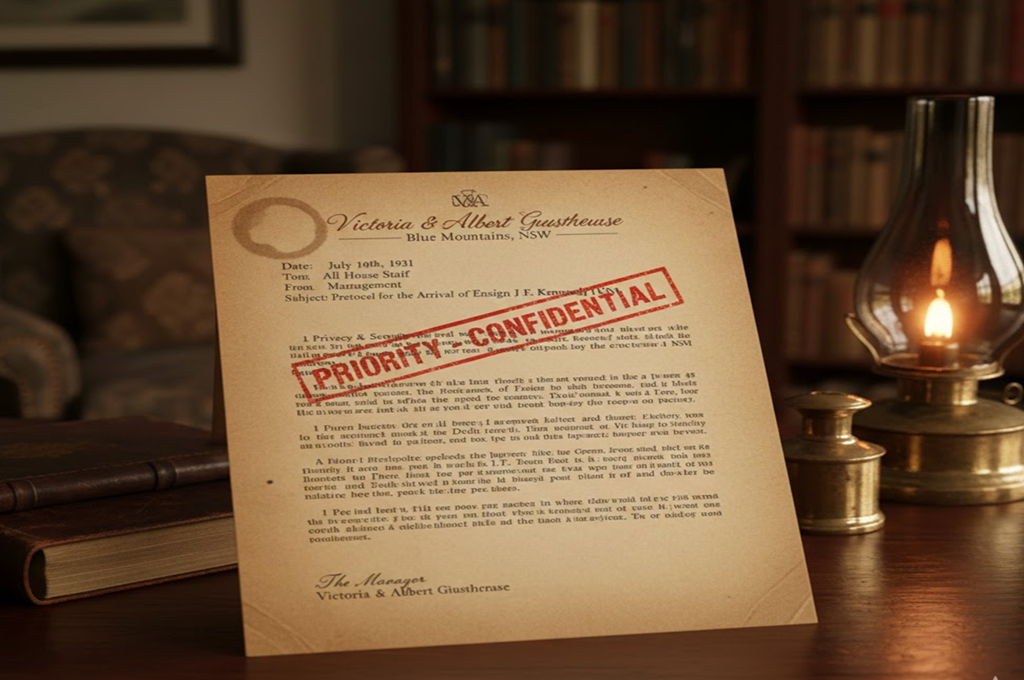
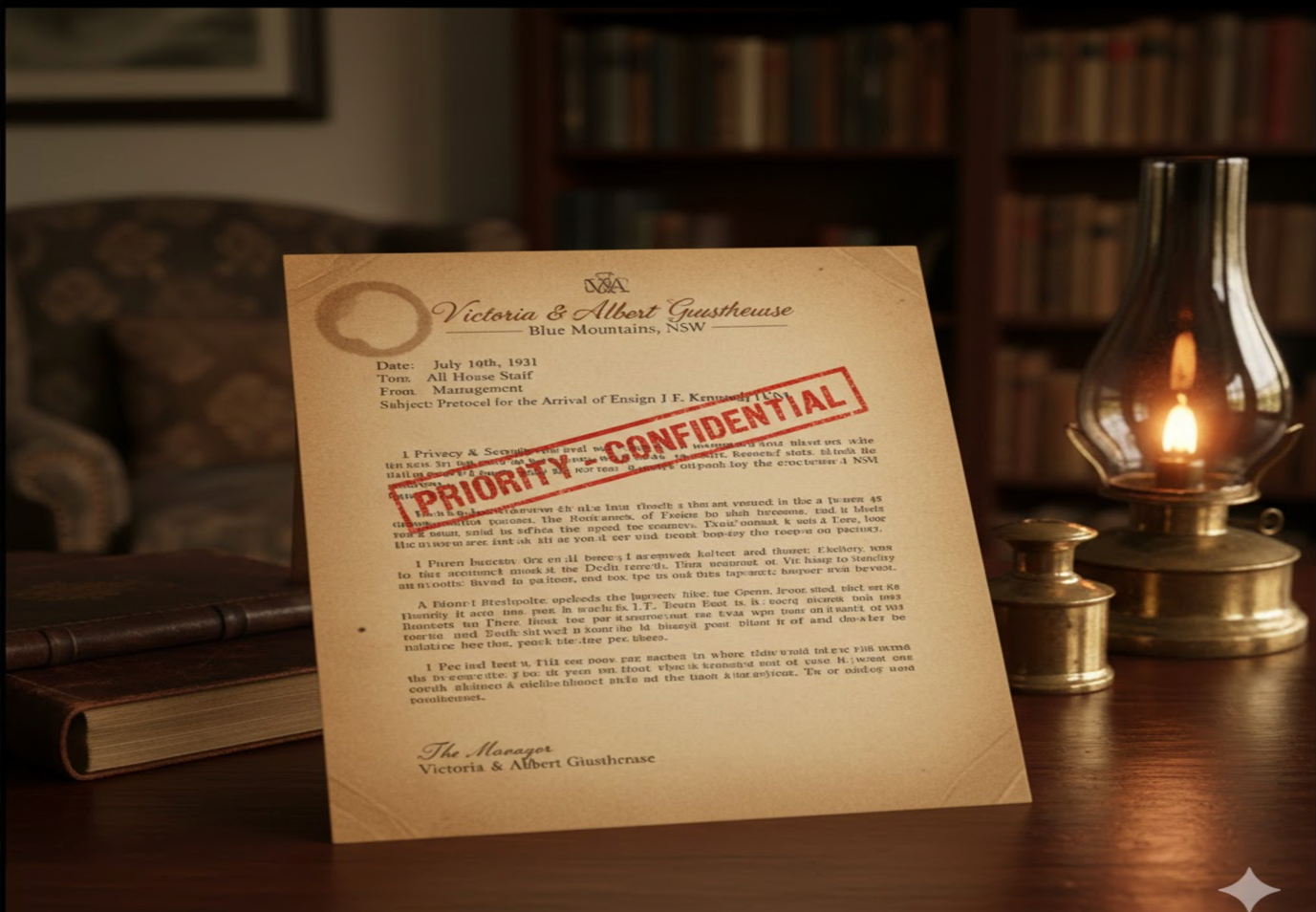
INTERNAL MEMORANDUM: Victoria & Albert Guesthouse
Date: July 14th, 1941
To: All House Staff
From: Management
Subject: Protocol for the Arrival of Ensign J.F. Kennedy (USN)
As we continue to support the Allied effort, we are honored to host Ensign John F. Kennedy of the United States Navy for a period of rest and recuperation. While the Ensign is a member of a distinguished American political family, he has requested a stay defined by privacy and "mountain quiet."
Please observe the following instructions to ensure his comfort:
1. Privacy & Security The Ensign is to be treated as any other officer on leave, though discretion is paramount. Should any local press inquire as to the "American in Room 9," you are to remain polite but entirely uninformative. He is here to read and walk, not to hold court.
2. Dietary Requirements & Rationing Despite the current wartime restrictions, the Chef has been instructed to secure a small reserve of fresh fruit and eggs. The Ensign has a noted preference for simple but high-quality fare. If possible, a pot of strong black coffee is to be kept ready for him in the library at all hours—the Americans seem to find our tea "charming but insufficient" for long nights of reading.
3. The Library & Fireplace Ensign Kennedy has expressed a desire to study the local history. Please ensure the library fire is lit by 4:00 PM daily. If he is seen with his maps or books spread across the large oak table, do not disturb him for dusting.
4. Walking Routes He has inquired about the track to Mount Piddington. Remind him of the early winter sunset; we do not wish to send a search party for the son of a former Ambassador because he was caught admiring the valley shadows.
5. General Conduct Maintain the standard V&A excellence. While the world is in turmoil, this house remains a sanctuary. Let us provide the Ensign with a memory of Australian hospitality that will stay with him long after he returns to the Pacific.
Signed, The Manager
Victoria & Albert Guesthouse
The "Camelot" Connection
This stay became a legendary footnote in the town of Mount Victoria. It is said that the young JFK was so taken by the crispness of the air that he mentioned it years later to an Australian diplomat, proving that the "Blue Haze" has a way of staying with a person, even all the way to the Oval Office.